
Ecommerce payment clearing accounts in Xero
Treat every payment method according to how money actually reaches the bank, rather than forcing all gateways through one account.
Map every method deliberately
ClearCommerce discovers the payment methods found in imported orders and lets the user assign the appropriate Xero account and treatment.
- Separate card processors and wallets
- Use a bank or clearing account that fits the workflow
- Retain the source payment method on the transaction
- Change mapping without changing the source data
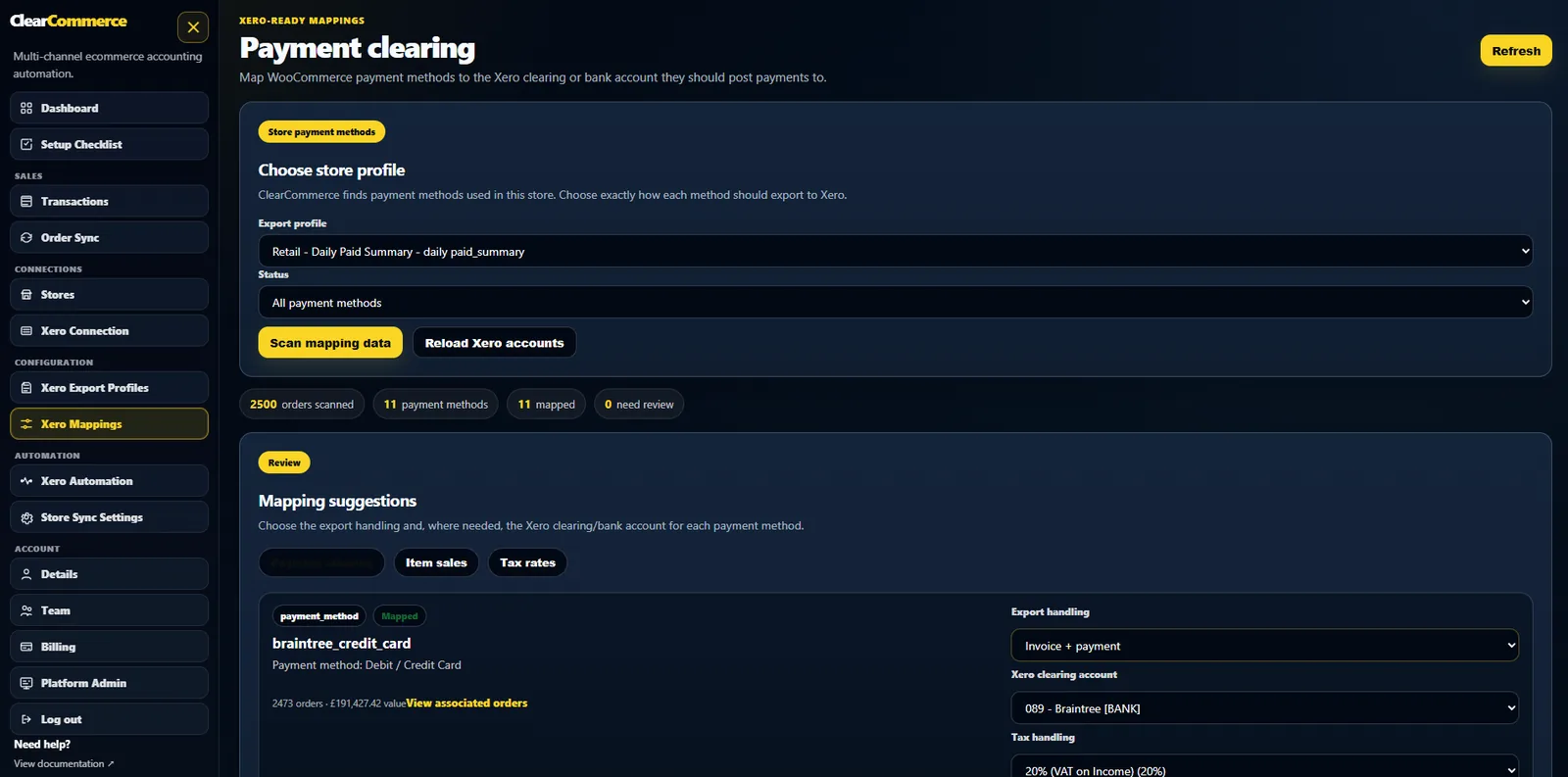
Choose the posting behaviour
The payment rule determines whether an invoice remains unpaid, receives a payment, contributes to a daily summary or is intentionally skipped.
- Invoice only and unpaid
- Invoice plus payment
- Daily summary treatment
- Skip unsupported or non-accounting methods
Clear accounting treatment
Configuration is stored against the company and store so the same source data can be reviewed, reprocessed safely and traced through its export history.
Reconcile settlement deposits cleanly
A gateway clearing account provides a place for gross ecommerce payments before processor fees and net bank settlements are matched.
- Keep gross sales separate from fees
- See gateway balances before settlement
- Use mapped fee accounts as support expands
- Improve the audit trail around bank reconciliation
Clear accounting treatment
Configuration is stored against the company and store so the same source data can be reviewed, reprocessed safely and traced through its export history.
What businesses usually ask
Does ClearCommerce hardcode Stripe, PayPal or Braintree accounts?
No. Payment method handling and the target Xero account are controlled through mappings.
Can a payment method create an invoice but no payment?
Yes. This is useful for BACS, trade terms and other methods where the invoice should remain outstanding.
Can the same payment method be treated differently by store?
Yes. Accounting treatment is tied to the company, store profile and mappings rather than being global to every customer.
Bring your current reconciliation problem
We will help you decide whether daily summaries, individual invoices or separate store profiles are the cleanest route.